


What Does Your Teeth Need: Restoration or RCT? Know the Difference

A toothache, cavity, or sensitivity can leave you wondering: Does my tooth need a simple dental filling, or is Root Canal Treatment (RCT) necessary? Understanding the difference between tooth restoration and RCT can help you make informed decisions about your dental health. Not every damaged tooth requires a root canal. In many cases, a dental restoration is sufficient to repair the damage and restore normal function. However, when decay or injury affects the pulp inside the tooth, Root Canal Treatment may be needed to preserve the natural tooth.
At The Smile Project Dental Clinic, Sector 70, Mohali, patient education is an important part of helping people understand their dental treatment options. Let us explore how restoration and RCT differ, when each may be required, and why an accurate dental examination matters.
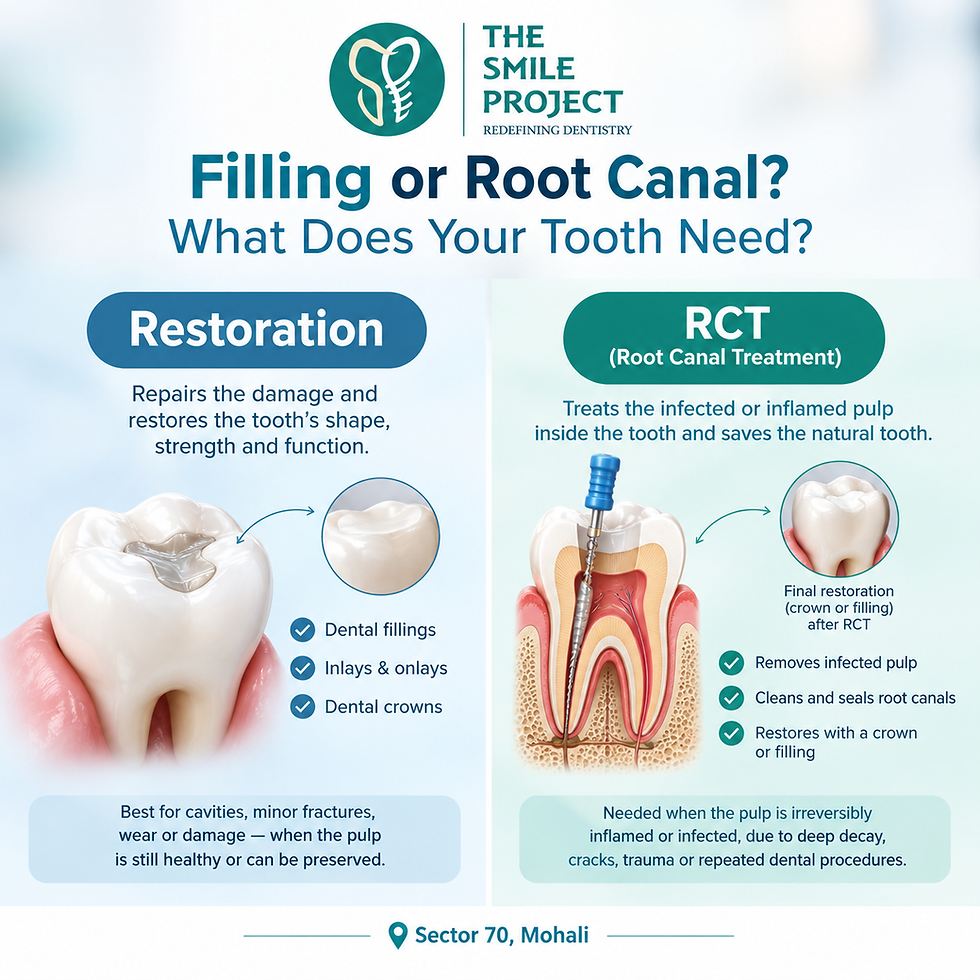
When Does a Tooth Need Restoration?
A tooth may need restoration when:
Tooth decay has damaged the enamel or dentin.
A small portion of the tooth has chipped or fractured.
An old filling has worn out or become defective.
Food gets trapped in a cavity.
There is sensitivity caused by exposed dentin or a cavity that has not irreversibly damaged the pulp.
For example, if a cavity has affected the outer layers of a tooth but the pulp remains healthy or can recover after appropriate treatment, a filling may be enough. The dentist removes the decayed tissue when indicated and restores the tooth with a suitable material.
What Is Root Canal Treatment (RCT)?
Root Canal Treatment is a procedure used to treat disease or damage involving the dental pulp, the soft tissue inside a tooth that contains nerves and blood vessels.
Deep decay, cracks, trauma, or repeated dental procedures can cause inflammation or infection of the pulp. When the pulp is irreversibly inflamed or infected, a simple filling may not adequately resolve the problem.
RCT helps eliminate the source of infection and preserve the natural tooth. The tooth may no longer contain living pulp tissue, but it can continue to function in chewing when properly treated and restored.
Signs That Your Tooth May Need a Dental Examination
Sensitivity to hot or cold: Brief sensitivity may occur with exposed dentin or a cavity. Pain that lingers after the stimulus is removed may indicate pulp inflammation.
Pain while chewing: This may result from decay, a crack, a defective filling, or inflammation around the root.
Spontaneous or nighttime toothache: Persistent or severe pain may indicate a more advanced problem involving the pulp.
Swelling: These can be signs of infection and require prompt dental assessment.
A deep cavity or broken tooth: The extent of damage determines whether a filling, crown, pulp treatment, or RCT is appropriate.
A darkened tooth after an injury: Trauma can damage the pulp even when the tooth looks intact.
Some teeth with significant pulp damage may cause little or no pain. Therefore, the absence of symptoms does not always mean that the tooth is healthy.
Can a Deep Cavity Be Treated Without RCT?
Yes, in some cases. A deep cavity does not automatically mean that a root canal is necessary.
If the pulp is healthy or its inflammation is potentially reversible, appropriate conservative treatment may preserve the pulp. Depending on the findings, this can include selective caries removal, a suitable protective material, or a vital pulp procedure.
Why Is the Final Restoration Important After RCT?
Completing RCT is only one part of saving a tooth. The tooth must also be sealed and protected against reinfection and fracture.
A permanent filling may be suitable for some teeth, depending on the amount and location of the remaining tooth structure. In other cases, a dental crown is recommended to provide additional protection, particularly for back teeth that experience significant chewing forces.
Frequently Asked Questions (FAQs)
1. Is a filling better than RCT?
Neither treatment is universally better. A filling is appropriate when the tooth can be repaired without conventional root canal treatment. RCT is used when the pulp requires treatment. The correct choice depends on the diagnosis.
2. Does every deep cavity require RCT?
No. Some deep cavities can be treated while preserving the pulp. The dentist must assess the symptoms, clinical findings, and X-rays to determine the appropriate treatment.
3. Can RCT be done without pain?
Local anesthesia is used to make treatment comfortable. Some tenderness may occur afterward, but it usually improves. Persistent or worsening pain should be reviewed by the dentist.
4. Is a crown always necessary after RCT?
No. The need for a crown depends on the tooth's location, the amount of remaining structure, and the risk of fracture. Many back teeth benefit from cuspal coverage, while selected teeth may be managed with other restorations.
5. What happens if I delay RCT when it is needed?
The disease may progress, potentially causing worsening pain, an abscess, or damage to surrounding tissues. Early assessment can help prevent complications and improve the chances of saving the tooth.
6. How can I prevent cavities and avoid extensive dental treatment?
Brush twice daily with fluoride toothpaste, clean between your teeth, limit frequent sugary snacks and drinks, and attend regular dental examinations. Seek dental advice early if you notice pain, sensitivity, or a cavity.
Need a dental assessment in Mohali?
Visit The Smile Project Dental Clinic, Sector 70, Mohali, to have your tooth evaluated and understand the treatment options suitable for your dental condition.


Comments